14 hours a day from his twenties until 2009
He still goes down to his studio and continues to work, and through this steady practice he keeps deepening his reflection on art.
Veteran Dansaekhwa master Park Seo-bo says he worked 14 hours a day for five decades and shaped his philosophy of art
He still goes down to his studio and continues to work, and through this steady practice he keeps deepening his reflection on art.
Park Seo-bo stressed that in art the process matters more than the result. For him, the process reflects a person's attitude to life, and he described painting as a tool for self-cultivation (susin). He emphasized that art is a path of character training that goes beyond simply making works.
He noted that the work itself is not the ultimate goal; the process and spirit contained in it matter more, and he expressed a sense of satisfaction with a balanced outcome.
Soft background music played as the narrative of Park Seo-bo's artistic world continued.
Park Seo-bo's signature Ecriture series began with his second son's scribbling. When his son tried to write a single character on graph paper and could not make it fit, he got frustrated and drew lines in anger. Seeing this, Park said he realized the aesthetic of resignation, and he changed his artistic direction by imitating his son's act.
Through countless repetitions, he explained, the artist purifies the self through the repetition of the act, and he argued that artistic work is the path to completing one's character.
Park Seo-bo argued that true art is only achieved once character is formed. He said that fine works are born only when an artist reaches a level of personal dignity, and that a good artist or leader must have the insight to see through the times. He also raised the question of art's role in an era when the earth is being shaken by stress.
Park Seo-bo believes the role of art is to heal people. He tries to bring the natural world in as a tool of healing, and said his work "Air" also started from this healing perspective. Things he constantly observes and feels are the source of his artistic inspiration.
After finishing a work, he said, he finds himself breathing deeply in front of it without realizing it, and he immersed himself deeply in the piece. This suggests that the artist's inner state is projected into the work.
Even if it takes a long time, Park Seo-bo's strong will to achieve his goal shows through. He stressed that even if it takes several years, he will not mind and will certainly accomplish it. This persistence and determination, he shows, is the driving force behind his artistic world.
Park Seo-bo stressed the necessity of growing through pruning a tree. He explained that for a tree to grow broad and large rather than tangled, unnecessary branches must be boldly cut away. This is a metaphor showing that in art, true growth is possible only when unneeded parts are emptied out and sacrificed.
He recalled that although he stopped pencil work in 1986, he began hanji work at the same time in 1982, and for five years worked on it at night in a place only he could see. This shows his attitude of constant effort and devotion to art.
With this attitude, he continues to try new things, such as ski-like sliding.
He explained that through various attempts he keeps searching for what feels fresher to him. He also compared his work to a cactus he brought from various places and planted until it bloomed, expressing the joy of new creation.
Park Seo-bo greeted a visitor who came to see him unpretentiously and agreed to be photographed. Saying "You came again?" and then "Take it," he welcomed the visitor warmly, showing the human side of a master.
Park Seo-bo places great meaning on observing everything. He said he draws inspiration from daily life and nature and captures the emotion of those moments in his paintings. He especially calls nature his teacher, emphasizing that he draws artistic inspiration from every phenomenon around him.
He added that giving one's best even in a fleeting moment is most important.
Answers come from the transcript, with the exact spot cited.
Want the next article from EBSDocumentary (EBS 다큐)?
When EBSDocumentary (EBS 다큐) publishes, we'll write it up like the one you just read and email it to you.
EBSDocumentary (EBS 다큐) published 191 in the last 7 days.
 80 Meals, One Day on a Two-Day Film LocationEBSDocumentary (EBS 다큐)yesterday · 19:37 · 676K views · Created yesterday
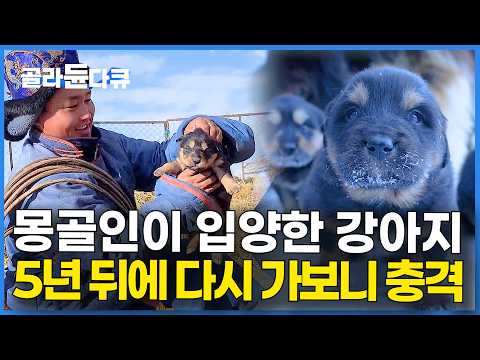 Mongolian Herding Dog Bankar Faces Down a Wolf: By Day It Chases Predators, By Night It Guards the Family's SleepEBSDocumentary (EBS 다큐)4 days ago · 24:33 · 257.4K views · Created 4 days ago
 Food critic who moved from Seoul to Inje and settled there visits a set meal of highland crops and wild mushroomsEBSDocumentary (EBS 다큐)6 days ago · 13:35 · 1.1K views · Created 6 days ago