SFA Semiconductor at 8,200 won: Will it recover to break-even?
SFA Semiconductor is a back-end (OSAT) company that handles general-purpose products such as DDR5.
Stocks from SFA Semiconductor at 8,200 won to tech name Makinas: two experts gave return rates, stop-losses and target prices.
SFA Semiconductor is a back-end (OSAT) company that handles general-purpose products such as DDR5.
However, he considered a 30% position too large and advised against additional buying. If the 6,200-won support is broken, he recommended reducing the position and rebuying at lower prices.
Yoo judged that setting a stop-loss price has little meaning.
The viewer holds Hyurim Robot at 97,000 won with a 60% position and voiced anxiety as the chart moved sideways with repeated swings up and down.
CEO Yoo Chang-hee explained that Hyurim Robot distributes and sells natural gas and LPG. Its business depends on seasonality, and its operating margin is below 3%.
With about 6.8 million shares in circulation, trading volume is thin, so liquidity problems may arise when selling.
Yoo judged that a 60% position is excessive and that such a stock should be held at under 10–20%.
CEO Yoo Chang-hee diagnosed a risk of memory supply shortage in the memory cycle. Semiconductor inventory falling below 10 days is the signal of supply shortage.
If there is spare cash, he recommended setting the average purchase price between 15,000 and 16,000 won (around the August peak) and preparing to respond easily when a rebound comes.
CEO Yoo Chang-hee pointed out that NJ, which runs EHD inkjet printing, glass substrates and lithium recycling in a mix, has an unclear business structure.
Since the AI software news in December 2025 (identifying defects in glass substrates), there have been no follow-up updates. With a market cap of 55.9 billion won and delisting requirements steadily tightening, the stock is risky.
Annual revenue has been declining and accumulated losses are piling up. He judged a 40% position reckless and said it is right to swap the stock if it rises near break-even.
CEO Yoo Chang-hee explained that VM supplies parts for semiconductor front-end equipment. As equipment makers keep receiving orders, VM's revenue can grow in step with those orders.
He judged that the 50,000-won purchase price could be reached at any time, and that whether it recovers above 60,000 won will be the turning point for reaching the target price.
CEO Kwak Yu-jeong said Hyundai Motor is under pressure as an exporter from the weaker exchange rate, and that adjustments will continue given US tariffs and union strike risks in the first half.
Hyundai Mobis operates an actuator business, and it is benefiting as sales of companies such as Robotis grow. He judged that stocks in the robot parts segment could move first.
He explained that Shinsegae reacts only to short-term issues without substance, while Samsung SDS, LG CNS and Naver lead the neocloud market.
Because the position is 30%, he judged a conservative approach is needed.
The upside scenario is a rebound zone around 16,000–17,000 won.
Battery makers used to source lithium from Chinese companies or Australian multinationals, but as the US keeps emphasizing supply chains free of China, battery companies are moving to exclude Chinese firms from material sourcing.
He judged that if a rebound comes, there is a high chance of taking profits around the 9,000-won zone.
CEO Yoo Chang-hee explained that EcoPro BM produces cathode material, while EcoPro Materials makes the precursor used as the cathode's ingredient.
Precursors produced by EcoPro Materials are likely to be supplied mainly to its parent, EcoPro BM.
However, it sits low in the trickle-down order, and it may take time for the parent's earnings improvement to be reflected.
He recommended not increasing the current 10% position, and instead diversifying into other secondary battery material and battery cell companies.
CEO Yoo Chang-hee assessed that US AI SaaS and security companies keep trending upward, but Korea has no company yet with comparable technology and revenue.
Makinas rose after listing on remarks by Jensen Huang and on the physical AI and robot themes, but its real technology is open to question. Quarterly revenue is around 300–400 million won with operating losses, so the growth benchmark is unclear.
It is currently forming a range of 20,000–32,300 won; if it breaks below 19,000 won, further decline is possible.
Demand for telecom equipment stocks keeps rising on stronger data center investment, but expectations of a return to profit next year are already priced in. He advised no additional buying until a recovery into the 20,000-won range is confirmed, and only watching the trend.
Answers come from the transcript, with the exact spot cited.
Want the next article from 매일경제TV?
When 매일경제TV publishes, we'll write it up like the one you just read and email it to you.
매일경제TV published 265 in the last 7 days.
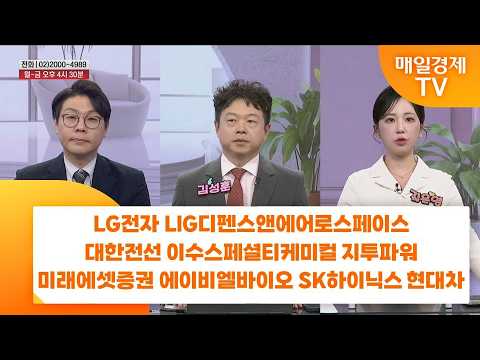 LG Electronics 250,000-won Target, LIG Nex1 Sell at 600,000 won, Hyundai Motor Hold for 500,000 won: Stock-by-Stock Investment Analysis매일경제TVlast month · 38:05 · 9.3K views · Created last month
 Foreigners Sell Six Days Straight, Yet Only Shipbuilders Are Bought매일경제TVlast month · 15:18 · 5.9K views · Created last month
 KOSPI Falls Below 6,000 as End of Buybacks Triggers Supply Shock매일경제TVlast month · 26:09 · 6.1K views · Created last month
