Lee's Erratic Conduct and Preview of Falling Approval Analysis
There is concern that he will push even harder moves to resolve his own legal risk. The question was raised of how much further this could make South Korea worse.
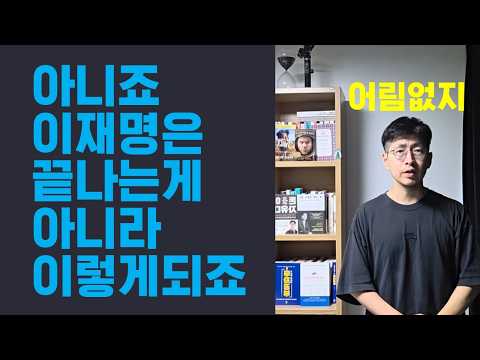
As Lee Jae-myung's approval among Seoul voters falls into the 30% range and his overall rating plunges, the drop is analyzed as the result of unpopular policies aimed at rallying hardline supporters and a focus on defending against legal risk.
There is concern that he will push even harder moves to resolve his own legal risk. The question was raised of how much further this could make South Korea worse.
Discussion is needed on how to analyze and respond to this situation, and on how Lee is likely to react. It was emphasized that the decline is not a simple phenomenon but has multiple underlying causes.
It was analyzed that Lee himself probably anticipated this decline. The drop is not sudden but is being driven by underlying causes.
It was pointed out that public broadcasters once served as a mouthpiece for Lee Jae-myung. The explanation was that this change in the media environment is affecting current poll results.
First, people are saying, 'Did you even believe those approval polls before?' We have to address that too. Until now, legacy media and public broadcasting were basically Lee Jae-myung's own microphone.
With the recent controversy over election fraud claims, the mood at public broadcasters is said to be changing. Public broadcasters are currently closer to the ruling power, which is linked to economic reasons, particularly the decline in advertising revenue. Public broadcasters, feeling financial pressure as the advertising market shifts to new media, are changing in line with the government's stance. It was pointed out that this change could be reflected in poll results.
This was cited as one factor behind Lee's falling approval. The point was emphasized that public broadcasters' coverage shapes public perception.
With the party congress approaching, it was analyzed that if Jung Chung-rae becomes party leader, Lee's defense against legal risk could become harder. Lee is therefore pushing risky policies to rally hardline supporters, it was explained. The strategic choice made to defend against legal risk is said to be affecting his approval.
Real estate policy was analyzed as having a major impact on Lee's approval. It was predicted that his real estate policy will certainly proceed along two lines: tighter regulation and tax increases. Such policies were said to provoke strong backlash from the public, especially Seoul residents, and to be a main cause of the decline in approval. Resistance to tax increases was pointed out as particularly strong.
More than half of Seoul residents are renters, and even among homeowners, many rent out rather than live in their homes, giving Seoul the highest rental share in the country. In the past, homeowners and renters reacted differently to tax increases, but now renters in Seoul too are voicing complaints over supply shortages and rising prices, making backlash against the policy stronger, it was explained.
It was pointed out that the current shortage of rental supply and continuing price increases are weighing heavily on Lee's approval. Jeonse listings are scarce and monthly rents keep rising, causing discontent for both landlords and tenants. Lee's low approval is being driven by dissatisfaction on both sides as tax increases hit landlords and tenants alike. The instability of the rental market was emphasized as a main cause of the shift in public sentiment.
They are said to cheer slogans such as 'Take what others have and share it,' 'Share the profits from semiconductors,' and 'Take the homes of landlords,' and they regard homes not lived in as speculative assets. They also show strong support for regulation and expropriation, casting multi-home owners as villains. It was added that this support base tends to dislike an ownership-based society in which people own and take responsibility for their homes.
Lee is described as a figure who would be hard to return to a free-market economy and a normal state, so he has no option other than regulation and tax increases, it was explained. Such policies were said to inevitably lead to falling approval. Legal risk was emphasized as the most important factor in Lee's policy decisions.
Such conduct was analyzed as showing a strong determination to defend against legal risk even at the cost of falling approval among the public. It was pointed out that he focuses on resolving legal risk rather than maintaining policy consistency.
Lee's falling approval was analyzed as having a negative effect on the Democratic Party as a whole, and discontent is growing even within the party. It was assessed that if Jung Chung-rae becomes party leader, the likelihood of Lee being checked or sidelined rises. Lee therefore wants Kim Min-seok to become party leader to protect him, and described this as having 'cast the dice.' He is said to be willing to accept falling approval and damage to the party in order to make removing his legal risk the top goal, pressing ahead with real estate regulation and tax increases. Critics argued that he cares only about managing his own legal risk, despite the damage to residents' housing conditions and the chaos in the property market.
The first is changes in the media, particularly shifts in public broadcasters' stance affecting public opinion. The second is Lee's own choices, with reckless moves focused solely on defending against legal risk through hardline supporters leading to the decline. The third is the choices of the public: in Seoul especially, interest in the election fraud issue is high, and while Lee and the Democratic Party have stayed silent on it, the People Power Party has spoken out, raising the approval of the PPP and of Jang Dong-hyeok and Jeon Won-gil. It was also stressed that residents who feel the turmoil in the KOSPI market, the worsening economy, sluggish domestic demand, and the hardships of life in Seoul are changing their view of Lee. The conclusion was that these three factors together make a decline in Lee's approval unavoidable.
For impeachment to be possible, the institutional system would have to be in place, but given the Democratic Party's current situation, this was pointed out as very difficult. Without the cooperation of the Democratic Party, it is not easy to move forward with impeachment proceedings.
Because the Democratic Party's approval is falling due to Lee, the impact of the next party leader on the next presidential race has become important. Lee has strongly argued that Kim Min-seok must become party leader so that his own trial can resume. Jung Chung-rae, on the other hand, is eyeing the next presidential race, so he is expected to be troubled by the drop in Democratic Party approval caused by Lee. Lee has placed a big bet, but it was noted that if public and media pressure grows, Kim Min-seok could still betray Lee even after becoming party leader. It was added that Kim's past betrayal of former President Roh Moo-hyun is still discussed within the Democratic Party.
Answers come from the transcript, with the exact spot cited.
Want the next article from 얼음공장의 반백수 프로젝트?
When 얼음공장의 반백수 프로젝트 publishes, we'll write it up like the one you just read and email it to you.
얼음공장의 반백수 프로젝트 published 35 in the last 7 days.
 Democrats' 'Insurrection Frame' Faces Risk of Backlash얼음공장의 반백수 프로젝트last month · 11:27 · 886 views · Created last month
 Ice Factory Earnestly Appeals to Join Gaecheonjeol Rally얼음공장의 반백수 프로젝트last month · 11:17 · 391 views · Created last month
 The film 'Assassins' is a propaganda tool that distorts history얼음공장의 반백수 프로젝트last month · 12:14 · 1.6K views · Created last month
