SK hynix Reaches DRAM No. 1 on Strong HBM Sales
In particular, its share of the overall DRAM market reached 38.7% in the second quarter of last year, pushing it past Samsung Electronics to the top of the industry.
The gap between HBM and general DRAM prices and the spread of long-term contracts are the key drivers behind the ranking shifts.
In particular, its share of the overall DRAM market reached 38.7% in the second quarter of last year, pushing it past Samsung Electronics to the top of the industry.
In the second quarter of this year, Samsung Electronics regained first place with a 39.4% share of the DRAM market.
SK hynix placed second with 24.9%, followed by Micron at 23.3%. The gap between SK hynix and Micron has narrowed to 1.6 percentage points, fueling concerns that SK hynix could drop to third.
In the second quarter of this year, SK hynix's DRAM revenue rose 37.9% from the previous quarter, while Micron posted a far larger 65.5% revenue increase over the same period.
This was the result of Micron concentrating on server DRAM sales, where prices rose more sharply. SK hynix also grew its revenue, but its rivals grew faster.
HBM follows a fixed-price contract model, in which production preparation and price negotiations proceed in advance according to the performance and volume the customer requires. This model rests on long-term relationships with customers.
General DRAM, by contrast, can reflect market price changes relatively quickly, allowing producers to respond right away to a market where prices have doubled or even tripled this year.
Because SK hynix has a high share of HBM, its fixed contract prices make it hard to book the general DRAM price surge immediately, which lowered its relative revenue growth.
In this way, HBM competition is expanding beyond memory technology into design competition around connecting with logic chips, where each company's foundry capability and partnerships matter.
Micron disclosed this type of contract through a U.S. regulatory filing.
This shift reflects the supplier advantage that chipmakers have gained as AI data center demand has grown. Customers now prioritize securing firm supply, even if it means accepting higher prices.
Long-term contracts with Take-or-Pay terms obligate customers to pay the agreed amount even if they do not receive the volume. As a result, the old practice of ordering generously and cancelling later has become difficult.
Some chipmakers, including Samsung Electronics and Micron, receive advance payments of roughly 20 to 25% under these contracts. This helps offset the risk of large factory investments and stabilizes production planning.
Suppliers are also separating volume discussions from price negotiations to secure contract flexibility, and a trend is emerging of setting price ranges within contracts to prevent sharp swings.
According to TrendForce, the wafer-level profitability of some server DDR5 products in the first quarter of this year is estimated to have surpassed that of HBM. This points to a strong recovery in the general DRAM market.
The improved profitability of general DRAM is being used as grounds for raising HBM prices, and overall supply shortages in the memory market are further increasing the value of HBM production.
Reflecting the expanding share of HBM4 and the effect of new shipments, TrendForce's analysis projects that the average selling price in 2027 will jump about 121% from this year. The more a company's revenue depends on these products, the wider its growth gap is likely to become, and SK hynix's earnings rebound is expected to hinge on these market conditions. The figure includes the effects of a larger HBM4 share and new product shipments.
Companies with a high share of HBM sales are more likely to gain an edge in revenue growth when product prices rise.
Accordingly, SK hynix's HBM share is expected to become a key factor driving its overall earnings recovery.
In the past, memory makers forecast demand, invested in factories, and bore all the inventory risk. Now, customers increasingly commit to multi-year volumes, pay advances, or take on purchase obligations.
This change is spreading across AI infrastructure, including semiconductor substrates and cooling equipment, showing an environment where securing supply on time matters more than the purchase price to keep AI data centers running smoothly.
Previously, chipmakers forecast demand, invested accordingly, and bore the full risk of inventory and price declines. Now, the deal structure is changing, with customers committing to multi-year volumes or paying in advance.
This change carries the possibility of penalty payments if AI investment slows, but because orders are harder to scale back freely as before, it helps manufacturers plan production more stably.
Long-term contracts are spreading beyond memory to AI data center components overall, including semiconductor substrates, power equipment, and cooling systems.
Securing needed parts on time has become more important than price competitiveness in order to keep data centers on schedule. This is because the structure is such that a shortage of even one component can delay the entire operating timeline.
Beyond market share, the share of long-term contracts and the stability of supply have emerged as key variables that will determine future rankings. SK hynix's ranking shift stemmed from multiple factors, including the sharp rise in general DRAM prices, rather than a decline in HBM technological competitiveness.
Next year's HBM price trajectory and the share of long-term contracts are expected to be the key variables determining manufacturers' earnings and rankings. Going forward, contract terms and supply stability will need to be considered alongside simple market share.
Answers come from the transcript, with the exact spot cited.
Want the next article from 안될공학 - IT 테크 신기술?
When 안될공학 - IT 테크 신기술 publishes, we'll write it up like the one you just read and email it to you.
 Hyundai Motor Group Unveils Atlas Mass-Production Strategy: Shorter Build Times and Lower Costs안될공학 - IT 테크 신기술3 weeks ago · 17:19 · 203.3K views · Created 3 weeks ago
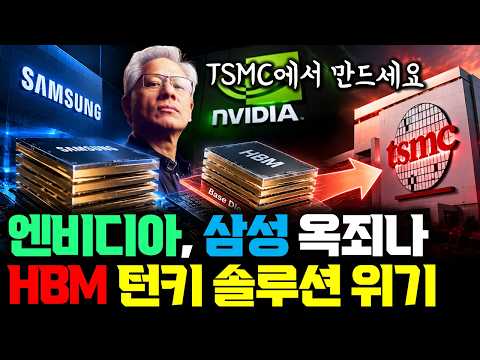 Nvidia Asks for TSMC 3nm Process for Custom HBM Base Die, Adding Variable to Samsung's Supply Strategy안될공학 - IT 테크 신기술3 weeks ago · 14:48 · 73.4K views · Created 3 weeks ago
 OpenAI in Dispute Over Firing of Safety Researchers안될공학 - IT 테크 신기술last month · 18:04 · 54.9K views · Created last month