FOMC minutes, as expected, show caution on upward inflation pressure
In particular, concerns from the Fed and the International Monetary Fund (IMF) about the structural vulnerabilities of AI investment were reconfirmed.
Despite the hawkish tone of the Fed's FOMC minutes, the market is placing its hopes on medium- to long-term rate stabilization, and attention is turning to whether SK Hynix's expanded shareholder return could trigger a re-rating of Korean stocks that have been undervalued.
In particular, concerns from the Fed and the International Monetary Fund (IMF) about the structural vulnerabilities of AI investment were reconfirmed.
Support for a hold also comes from the time remaining before the year-end submission of Kevin Warsh's task force recommendations, and from the expectation that adjusting how September personal consumption expenditures (PCE) inflation is calculated will lower the inflation rate by 0.2 to 0.3 percentage points.
Jung Da-un of LS Securities stressed that "the buyback size has more than doubled, and what matters more than the number is that the Treasury is paying attention." However, some point out that expanded buybacks are not a fundamental solution. With U.S. debt surpassing $40 trillion and structural fiscal deficit problems persisting, macro uncertainty is likely to remain a constant until policy credibility is restored.
Analysis suggests that, through government efforts and market movements, medium- to long-term rates may have already peaked. Lee Sang-yeon, research fellow at Shinyoung Securities, said, "Even so, I think there's a possibility that medium- to long-term rates have already topped out." Four factors are cited as supporting medium- to long-term rate stabilization. First, easing geopolitical risk, though concrete progress is still lacking. Second, an economic slowdown due to high rates is expected, but that will take time. Third, restoring confidence in the Fed's inflation response could lower the term premium. Fourth, institutional measures such as the Treasury increasing buybacks and responding to stablecoin issues are expected to help stabilize rates.
Lee Sang-yeon of Shinyoung Securities analyzed that "the market itself is taking it as a positive signal," and added that although Kevin Hassett, the new Fed chair, is someone who seeks to minimize communication with the market, it is a period with important events that is worth looking forward to. Following the release of the FOMC minutes and with key market events such as the Jackson Hole meeting next week, the prevailing mood in the market leans toward positive interpretations.
The U.S. fiscal deficit is viewed as a risk the market already recognizes. Lee Sang-yeon of Shinyoung Securities noted that "the growing fiscal deficit in the U.S. is not something that happened just a day or two ago, so the market already knows it." In particular, as U.S. concern grows over Japan selling U.S. Treasuries to adjust the yen exchange rate, the U.S. Treasury and other parts of the administration have expressed a strong commitment to managing the currency. This suggests that attention to exchange rates is higher than ever.
Lee Sang-yeon of Shinyoung Securities emphasized that when activating stablecoins, it is important to have them use U.S. short-term Treasuries as reserve assets, and that institutional arrangements are urgently needed for this. From this perspective, there are signs of a push to rapidly institutionalize stablecoins, while the Treasury is currently issuing government bonds centered on short-term maturities. This is interpreted as an intent to have stablecoins absorb the demand created by increased short-term issuance, and to ease rate pressure by adjusting the supply of medium- to long-term coupon bonds.
Lee Sang-yeon of Shinyoung Securities assessed that the announcement was well timed, given that SK Hynix is listed as an ADR (American Depositary Receipt) and inevitably gets compared with global peers such as Micron and Sandisk. Raising the payout ratio from within 50% of FCF over the past three years to 50% or more is read as a declaration that the company will return more to shareholders the more it earns, creating a more attractive setting for investors. Given criticism that Korean companies have been stingy with shareholder returns, this is expected to address the discount on Korean large caps more broadly and create an opportunity for re-rating, by taking shareholder capitalism into account.
Lee Sang-yeon of Shinyoung Securities said it was "announced at a time when it was needed," and assessed that it provided reassurance after the stock had bounced off its lows and then wavered again. Including dividends, the return is expected to amount to roughly 100 trillion won, a level that meets market expectations. The announcement not only raises the floor but could also lead to expectations of shareholder returns at Samsung Electronics, Korea's largest company by market capitalization. There is also a possibility that Samsung Electronics announces its own shareholder return policy around the end of the third quarter.
Although the semiconductor industry itself remains positive, the outlook suggests constraints on any shift toward a sustained uptrend in the stock price. Lee Sang-yeon of Shinyoung Securities said that while the chip cycle is good, there are "concerns about how long GPU (graphics processing unit) margins can be maintained, as with Nvidia." In addition, the market's focus is shifting away from semiconductor bottlenecks, and efforts to resolve those bottlenecks are underway, which is a variable. For further gains, valuation re-rating is needed, and that requires confirming that margins have bottomed and making visible the expectation that high levels will be sustained, according to the analysis.
Accordingly, a rotation strategy between semiconductor and non-semiconductor sectors is expected to be effective.
Jung Da-un of LS Securities explained that "memory semiconductors are one sector within the larger AI theme, and globally, the AI theme has not died; rather, rotation is happening within the AI theme itself." In other words, investors should look for new opportunities in other sectors, such as materials, parts and equipment (sobujang) where bottlenecks arise within AI infrastructure.
For financial stocks, a re-rating based on shareholder return policies is possible, but a conservative approach is needed for further share price gains. Lee Sang-yeon of Shinyoung Securities said, "Bank stocks can still be re-rated for their higher shareholder returns, but if you ask whether the share price will break out further from here, there is some conservatism." Insurance stocks are viewed positively because they have room for further shareholder return increases, while securities stocks are expected to struggle to deliver excess returns without an index rally.
This is analyzed as reflecting a stronger tendency among foreign investors to focus on high-growth sectors such as AI infrastructure rather than reacting to currency fluctuations.
Jung Da-un of LS Securities advised that "this is essentially a period of time-based adjustment, and a tedious range-bound market is expected for now, so rather than trend-following strategies..." In this environment, a strategy of selecting and buying stocks that have fallen excessively relative to their fundamentals appears more effective than trend-following.
Recently, even though Samsung Electronics and SK Hynix declined, materials, parts and equipment (sobujang) stocks showed an independent rebound. Lee Sang-yeon of Shinyoung Securities explained that "what changed in the market yesterday was that Samsung Electronics and SK Hynix fell, and their declines were large, yet sobujang stocks rebounded strongly." This suggests that a rotation is taking place within the market, and it is worth closely checking whether this independent strength continues.
Answers come from the transcript, with the exact spot cited.
Want the next article from 매일경제TV?
When 매일경제TV publishes, we'll write it up like the one you just read and email it to you.
매일경제TV published 290 in the last 7 days.
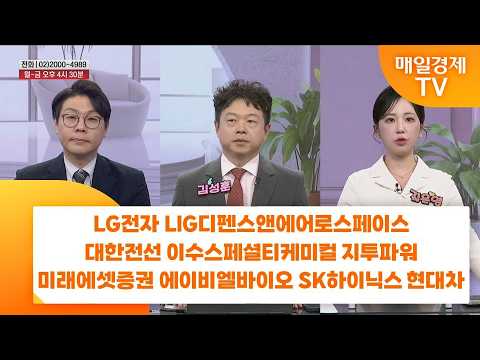 LG Electronics 250,000-won Target, LIG Nex1 Sell at 600,000 won, Hyundai Motor Hold for 500,000 won: Stock-by-Stock Investment Analysis매일경제TV3 weeks ago · 38:05 · 9.3K views · Created 3 weeks ago
 Foreigners Sell Six Days Straight, Yet Only Shipbuilders Are Bought매일경제TVlast month · 15:18 · 5.9K views · Created last month
 KOSPI Falls Below 6,000 as End of Buybacks Triggers Supply Shock매일경제TVlast month · 26:09 · 6.1K views · Created last month
