Hyundai to unleash 100+ new models worldwide by 2030
The lineup includes full redesigns, partial changes and derivative models. In particular, more than 18 of these will launch in vehicle segments that Hyundai has not previously entered.
Hyundai Motor laid out its mid- to long-term growth strategy: more new models, expanded production capacity, investment in future mobility, a higher profitability target, and stronger shareholder returns.
The lineup includes full redesigns, partial changes and derivative models. In particular, more than 18 of these will launch in vehicle segments that Hyundai has not previously entered.
Specifically, it will expand output by 500,000 units in North America, 320,000 in India and 200,000 in Korea, aiming for total annual sales of 5.55 million units.
Hyundai will accelerate its market push with region-specific strategies. In North America, it will launch 10 hybrid models and aims to raise hybrids to 50% of its total sales there. In Europe, it targets expanding EV sales to 420,000 units, nearly four times last year's level. Its premium brand Genesis will introduce hybrid models, and next year it plans to unveil an extended-range electric vehicle (EREV) that can travel more than 1,000 km on a single charge or tank of fuel.
Hyundai will also actively grow its robotics and autonomous driving businesses, using the funds and manufacturing capabilities from its core automotive operations. Starting in the fourth quarter of this year, it will begin supplying Waymo with robotaxis built on the Ioniq 5 at its Georgia, USA plant. In 2028, it plans to deploy the Atlas industrial humanoid robot at the same plant and apply Level 2+ autonomous driving technology to its first software-defined vehicle. In 2029, it will also bring an artificial intelligence (AI) data center online in Saemangeum.
Hyundai has also raised its profitability target by leaning on new-model expansion and cost reductions. It will raise its 2030 operating margin target from the previous 8–9% to 9% or higher, and expects its operating profit to be 11% larger than under the previous plan. Through cost innovation across the entire process from vehicle development to production and after-sales service, along with material cost reductions and localized production, it plans to cut its cost of sales ratio by 3 percentage points versus the previous plan.
Hyundai will continue its policies to boost shareholder value. It will maintain a total shareholder return ratio of 35% or higher and a minimum annual dividend of 10,000 won per share, and it has decided to retire all of its existing treasury shares worth about 800 billion won, excluding those reserved for employee compensation. This is seen as a clear signal of its intent to expand shareholder returns.
Answers come from the transcript, with the exact spot cited.
Want the next article from 매일경제TV?
When 매일경제TV publishes, we'll write it up like the one you just read and email it to you.
매일경제TV published 265 in the last 7 days.
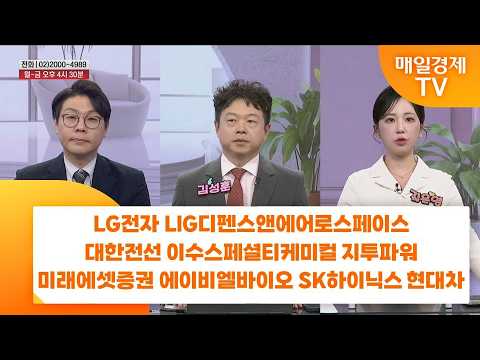 LG Electronics 250,000-won Target, LIG Nex1 Sell at 600,000 won, Hyundai Motor Hold for 500,000 won: Stock-by-Stock Investment Analysis매일경제TVlast month · 38:05 · 9.3K views · Created last month
 Foreigners Sell Six Days Straight, Yet Only Shipbuilders Are Bought매일경제TVlast month · 15:18 · 5.9K views · Created last month
 KOSPI Falls Below 6,000 as End of Buybacks Triggers Supply Shock매일경제TVlast month · 26:09 · 6.1K views · Created last month
